

Posted by Communications Liaison Ellie Simpson, thanks to Archivist Jon Coss.
Alfred Lawton Hammett was born about 1850 to Charles and Elizabeth Hammett in Newport, Rhode Island, where his father owned and operated a stationery and book store. He attended the local school, worked in his father’s store, and in 1875 married Elizabeth Burdick. After they moved to Brooklyn, he became a teller at the National Bank of Commerce. In 1882 they moved to Pelham and joined the Huguenot Church. He served as a trustee, treasurer, elder, Clerk of Session, and Sunday School Superintendent. After years of commuting into Manhattan, he became manager of The People’s Bank for Savings of New Rochelle. He was known for arriving at his desk, even at age 85, promptly at 8:15 a.m. each day. His daughter Anne was the church organist. His son Alfred Dumond Hammett married and had three children.
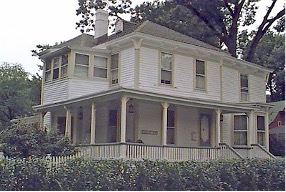
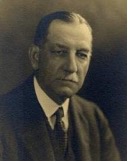
The Hammett house at 1030 Clay Avenue. His neighbor, Henry W. Taft, who saved his life.
The outstanding event of Hammett’s life was the Great Blizzard of 1888. He and Henry Waters Taft (a large man, a lawyer, and younger brother of the future U.S. president) recorded their memories. Dr. Charles Gillett, a Pelham resident and HMC member, was not on the Pelham train on the day of the blizzard, but he wrote down his recollections.
Henry W. Taft remembered, “A warm misty rain fell on Sunday, March 11th, turning to snow during the night. Monday morning the storm seemed a heavy one but not unusually so. The train, however, on which I expected to travel to New York, scheduled for six o’clock, was already an hour late. The storm increased in violence, and the snow rapidly gathered in gigantic drifts, while the wind howled from the north and blew a gale.”
Dr. Gillett wrote, “The storm of wind and snow began on March 12. The snow drifted before the wind, and became very deep in places. The temperature fell to six degrees below zero, and those whose supply of coal was low, suffered severely, for coal could not be delivered…. A few Manorites tried to reach the City on Monday by the Branch Line. The train reached the station at Westchester Square [now part of the Bronx], but could not get further on account of the snow that had drifted into the cut [excavation] just beyond the station. There the train stuck, and the passengers, after burning all of the fuel available, began to break up the seats.”
Taft recalled that he and Hammett spent eight hours in the railcar as the wind “penetrated the loose joints of the old-fashioned wooden car.” They decided to “risk the perils” of going on foot through the snow. “Often we were forced to help each other out of drifts that were from five to ten feet high, sometimes being obliged to turn on our backs and roll out of giant drifts.”
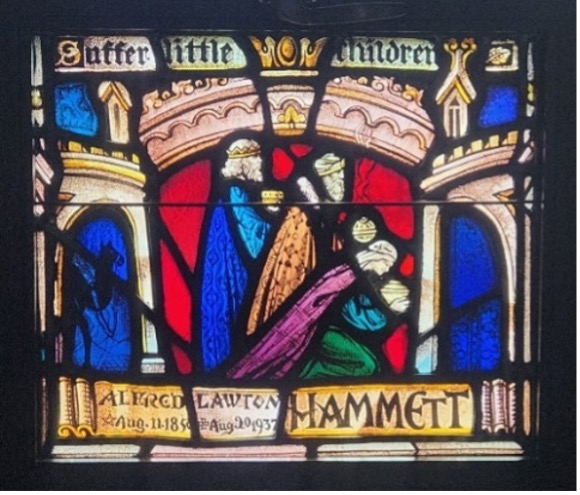
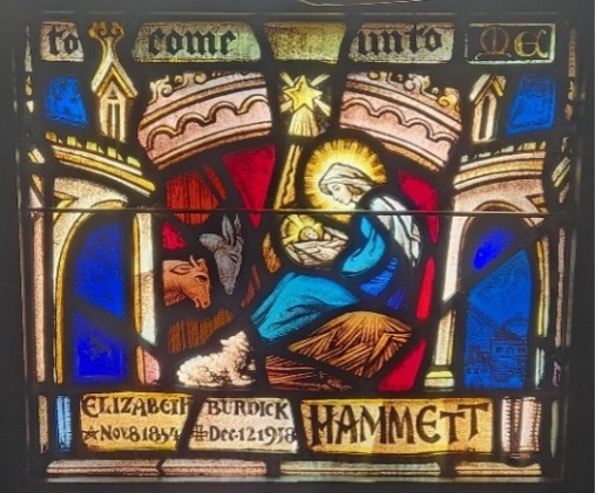
Details of the stained-glass window dedicated to Mr. and Mrs. Hammett. The Bible verse, “Suffer [allow] the little children to come unto me,” recognized their devotion to the Sunday School.
Sources:
Bell, Blake. Historic Pelham. http://historicpelham.blogspot.com/2015/11/alfred-lawton-hammett-important-early.html
Gillett, Charles. “Recollections.” The Pelham Sun, 25 July, and 19 Sept 1941. HMC Archives.
Hammett, Alfred Lawton “Reminiscences.” HMC Archives. Series 18. Anniversaries.
Highland, Margaret. The Windows of Huguenot. Huguenot Memorial Church, Buildings & Grounds Committee. Pelham Manor, New York, 2010.
Newport Historical Society. Charles E. Hammett. https://www.riamco.org/render?eadid=US-RNHi-Ms2013.32&view=biography
HMC Archives. Session Minutes. Hammett Tribute. 3 Nov 1937. Vol. 8, 1935-1947.
Taft, Henry W. https://virtualny.ashp.cuny.edu/Search/search_res_text4d7f.html?id=408
Wikipedia. Great Blizzard of 1888. https://en.wikipedia.org/wiki/Great_Blizzard_of_1888. Henry Waters Taft. https://en.wikipedia.org/wiki/Henry_Waters_Taft. Frostbite. https://en.wikipedia.org/wiki/Frostbite. Plastic surgery. https://en.wikipedia.org/wiki/Plastic_surgery